Data Science & Bioinformatics for Mass Spectrometry of Small Molecules
We build efficient algorithms, tools and workflows to identify and quantify lipids and other small molecules — applied to human, microbial and plant lipidomics.
Four directions, one pipeline
From raw names and spectra to comparable, shareable results — each direction backed by an open-source tool or standard.
Harmonized naming and representation of ambiguity
Fast, exact algorithms for annotating small molecules are the core of our work. We treat lipid names and structures as formal objects that software can parse, normalize and compare — so identifications are consistent across labs, tools and databases.
Targeted & quantitative workflows
Alongside untargeted discovery, we build reliable targeted and quantitative methods — the assays and spectral libraries needed to measure defined panels of lipids reproducibly.
Comparison, ML & cloud analysis
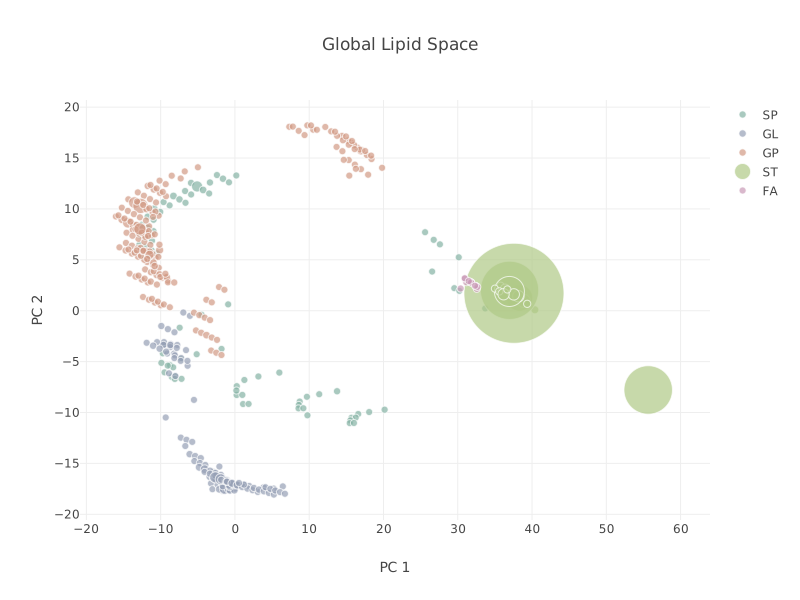
We turn results into interpretable comparisons between whole lipidomes, and are beginning to complement our exact algorithms with machine learning, delivered through reproducible, cloud-native workflows.
| Name | Study A | Study B | Study C |
|---|---|---|---|
| PC 34:1 | 0.42 | 0.38 | 0.51 |
| PE 36:2 | 0.18 | 0.22 | 0.15 |
| TG 52:3 | 0.27 | 0.31 | 0.24 |
| SM 34:1 | 0.09 | 0.07 | 0.10 |
FAIR data & standards
Methods only matter if their results can be shared and reused. We help define the community data standards that make small-molecule mass spectrometry interoperable and AI-ready.
Making MS data FAIR
We help define community data standards through the HUPO Proteomics Standards Initiative — quality metrics, reporting and AI-readiness for small-molecule mass spectrometry.
Open-source software we build
As part of the German Network for Bioinformatics Infrastructure (de.NBI) and ELIXIR Germany - LIFS consortium — we contribute to a connected suite of lipidomics tools, from identification to structural comparison.